
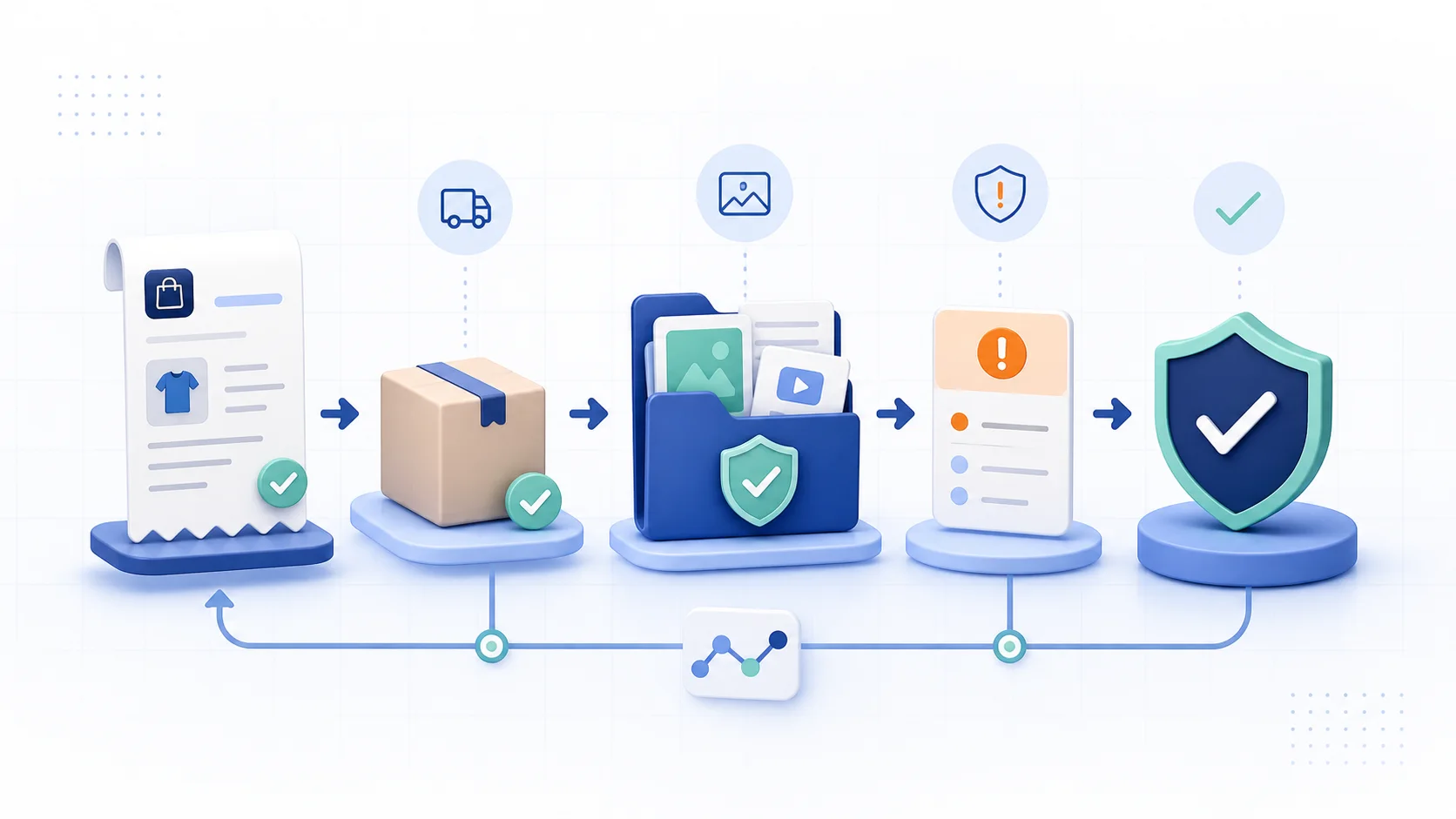
To reduce chargebacks on Shopify, use several small controls at the right points: review why disputes happen, check order risk before fulfilment, set accurate expectations before checkout, keep useful records, and answer each dispute with relevant evidence.
No checkbox, email, tracking service, or app can prevent every chargeback. The useful goal is a repeatable process that helps your team catch avoidable problems and respond clearly when a dispute still occurs.
This is general operational information, not legal, financial, or payment-network advice. Follow the current instructions in Shopify Admin and from your payment provider.
The Shopify chargeback prevention checklist
Use this as the quick version. The sections below explain what each step means.
- Review recent chargebacks by reason, product, value, and fulfilment pattern.
- Inspect Shopify’s fraud analysis before fulfilling flagged orders.
- Put accurate product, shipping, return, and cancellation information near the purchase decision.
- Record policy acknowledgement when your storefront workflow genuinely requires it.
- Define an internal review process for high-value or high-risk orders.
- Keep order, delivery, and customer-communication records together.
- Respond by the deadline with evidence that matches the dispute reason.
Chargebacks share one label, but they are not one problem wearing different order numbers.
1. Start with the dispute reason
A fraudulent-transaction claim needs different prevention work from an item-not-received or product-not-as-described dispute. Before adding another tool, group recent cases into useful categories.
| Dispute pattern | First place to inspect |
|---|---|
| Fraudulent or unrecognized transaction | Pre-fulfilment risk review, statement descriptor, and order context |
| Item not received | Processing promises, tracking, delivery records, and customer updates |
| Product not as described | Product copy, images, variants, quality checks, and fulfilment accuracy |
| Refund or cancellation disagreement | Published policy, request history, and refund communication |
| Subscription disagreement | Recurring-payment and cancellation information shown before purchase |
Shopify’s chargeback monitoring guidance explains how reviewing recent dispute patterns can help merchants prioritize their risk-reduction work.
2. Review order risk before fulfilment
Shopify’s fraud analysis documentation describes indicators such as AVS and CVV results, IP context, and multiple payment attempts. Eligible orders can also receive a low, medium, or high fraud recommendation.
For an order that needs review:
- Read the available recommendation and indicators.
- Compare the billing, shipping, contact, and order details for inconsistencies.
- Check whether the order value, quantity, destination, or requested fulfilment is unusual for your store.
- Verify or hold the order according to your documented risk process.
- Record why the team decided to fulfil, cancel, or refund it.
An indicator is a reason to investigate, not proof that a customer is fraudulent. Plan availability and payment-provider behavior can also differ, so use the current information in the merchant’s own Shopify Admin.
3. Set expectations before checkout
Many avoidable disagreements begin before payment. Keep the details that affect the purchase current and easy to find.
Product page
- Describe the actual item, condition, size, materials, and included parts.
- Show the correct variant, price, subscription terms, or customisation requirements.
- State processing time for made-to-order, pre-order, or personalised products.
Cart and policy links
- Link the relevant refund, return, shipping, and cancellation policies.
- Surface final-sale, non-returnable, delivery, or custom-order conditions when they affect the decision.
- Use realistic time ranges instead of optimistic promises the fulfilment process cannot maintain.
After the order
- Send an accurate confirmation.
- Communicate material delays or changes promptly.
- Keep refund, replacement, or cancellation decisions in the order history.
The goal is not a wall of protective wording. It is to help the shopper understand what they are buying and what happens next.
4. Use a terms checkbox for the right job
A required terms checkbox can add an explicit storefront acknowledgement when a customer needs to accept a specific, accessible policy before a supported checkout path.
It can be useful for making an important return condition, shipping timeline, custom-order instruction, or other store policy visible before checkout. It can also carry the configured acknowledgement and time into the order details.
It cannot:
- identify a stolen card;
- prove that the cardholder placed the order;
- make unclear policy wording sufficient;
- cover an invoice or purchase path that bypasses the protected storefront step; or
- guarantee that a bank will decide a dispute in the merchant’s favour.
If policy acknowledgement is the missing step, read how to add a terms and conditions checkbox to Shopify. I Agree — Terms & Conditions Checkbox supports a store-wide agreement on supported cart, cart-drawer, and product-button paths.
5. Create a high-value or high-risk order review
An expensive order can justify an extra pause before fulfilment, but there is no universal Shopify rule that every order above $1,000 must follow. Set a threshold that makes sense for your average order value, product type, resale risk, fulfilment cost, and ability to recover the goods.
For orders that cross your store’s threshold:
- Review Shopify’s available fraud indicators and recommendation.
- Confirm the order details, requested customisation, delivery address, and expected timeline.
- Contact the customer through the details attached to the order if your review process calls for confirmation.
- Do not ask the customer to send card credentials or other sensitive payment data by email.
- Choose tracking, delivery confirmation, or signature service appropriate to the item and destination.
- Keep the confirmation and fulfilment decision with the order.
A concise message might ask the customer to confirm the order details and delivery timeline before dispatch. A reply can add useful order context, but it does not prove identity or guarantee a dispute outcome. If $1,000 is meaningful for your store, use it as your own documented threshold—not as a universal rule copied from a blog.
6. Keep communication and delivery records together
A customer who cannot find an update may contact the bank before the merchant. Set a support and shipping-update standard that your team can reliably maintain.
For physical orders, keep these records easy to retrieve:
- order confirmation and itemized amount;
- product page or offer relevant to the purchase;
- tracking number and carrier events;
- delivery confirmation when available;
- customer emails, chat, and support history; and
- refund, replacement, cancellation, or delay communication.
Use delivery evidence appropriate to the order’s value and risk. No tracking or signature method guarantees that an issuer will decide a case in the merchant’s favour.
7. Answer the dispute that was filed
When a chargeback or inquiry opens, review the reason, evidence deadline, and response fields in Shopify Admin. If the transaction used another payment provider, follow that provider’s current process.
Shopify’s chargeback response guide describes the response process and examples of relevant evidence. A focused response is usually more useful than a large file of unrelated material.
- For item not received, prioritize fulfilment, tracking, delivery, and customer communication.
- For product not as described, connect the purchase to accurate product information and the resolution offered.
- For a refund or cancellation disagreement, show the applicable policy and the dated request and response history.
- For a fraudulent-transaction claim, follow the requested evidence fields; a policy checkbox does not answer who used the payment method.
Shopify does not make or overturn the bank’s final decision. Evidence can support a response, not guarantee a win.
The monthly review
Once a month, ask:
- Which dispute reasons are increasing?
- Do they cluster around a product, country, fulfilment method, or order value?
- Were flagged orders reviewed before fulfilment?
- Are product, shipping, refund, return, and subscription details still accurate?
- Can staff retrieve the relevant order and communication records quickly?
- Did every open case receive a relevant response before its deadline?
That short review is more useful than waiting for the next dispute and rebuilding the process from memory. Keep Shopify’s current chargeback documentation as the operating reference.
If explicit storefront policy acknowledgement belongs in your process, review I Agree’s current fit and limitations before adding it. It should be one clear layer in the workflow—not a promise of chargeback protection.